New Book and Affirmations Update

I’ve blogged about affirmations before, and I continue my personal journey in modifying and implementing them on a daily basis. I find the many variations of the “right way” or “best way” to use affirmations insightful. Some sources tout a “say it even if it’s not true” discipline and others are firm in their belief that the statement must be true at the moment. Personally, I’m okay with the former as long as the statement feels true. So even though it may not be true at the moment I want it to be true, I know it will be true, I feel inspired to take action to make it true.

Case in point: I say the following affirmation: “My home is always clean and tidy, and my family helps keep it that way.” At this very moment, my home is no where near tidy, it’s fairly clean, and my family is getting better at putting dirty dishes in the dishwasher. I still say the affirmation every morning with conviction even though we are a long way from that statement being true. What it has done for me is put focus on this issue daily. Every day I’m reminded of my goal of a tidy house. Every day I take action towards that goal – some days a very small action, more at preventative maintenance; and some days large strides (laundry room completely cleaned out and rearranged!).

I’m curious how many of you have used or are using affirmations? How are they working – or not – for you?

From Almost Giving Up and Unstoppable

A Good Start

It took almost giving up to discover that I was unstoppable. Sometimes you have to just keep pushing until you get to the place where it all becomes easier.I was up early this morning, as I usually am. Only today I decided to shake up my routine a bit and head to the gym at 6:30 instead of the less crowded time of 9:30 or 10:00 a.m.  Now the “gym” in my little town in actually run by a physical therapist who serves as a personal trainer, Steve. It’s a great deal, but he cuts you no slack (in the nicest way possible!).

After 15 minutes on the elliptical, he tells me today is my “arms” day. Fifteen reps of five different exercises all while holding an 8-pound weight in each hand. (Don’t laugh, I’m new to the working out thing). By the end of the first round, I’m beat. Steve smiles (and not maniacally, but in a really friendly way, so it’s hard to say no) and tells me do another round. Well the first exercise of the round is to stand with legs apart, knees bent, arms straight down holding weights, and swing both arms out in front and all the way up. I thought I would die. Really. After about five, I took a short-ish break. I did five more. I paused. (That’s a way of saying took another break). I think I managed the last five, but it may have only been four. Or three. The rest of the round went a bit better (less pausing). Sweat was pouring down my face and back. I was sure I would pass out.

Almost Giving Up

I wanted that to be the end. My mind was racing with a thousand excuses as to why this exercise thing was not necessary. I mentally fought back that it was necessary, although maybe I’d done enough for today. Steve didn’t think so.

“Alright then, let’s do one more round.”

“Really? Because I think I may collapse.” And if it weren’t for the fact that Steve is possibly the nicest guy on the planet, I would have said that out loud. But I didn’t. I grabbed a sip of water and began round three.

“This first exercise is really killer, Steve.”

“It’s the one that shakes everything into really working.”

“Oh.” Guess that translated into I can’t skip it. This time I could only manage three before taking an extended pause. A pause that involved getting another sip of water and sitting down. But if Steve believed I could do it, then I guess I better give it a go. And I did. It wasn’t easy. And it involved a couple more short pauses, but those last 5 reps were awesome. I found some deep inner strength and gave it my all. I think they may have been the very best reps of the whole morning. I was unstoppable. And as I completed the other 4 exercises in the round, I reminded myself of that: unstoppable.

I left the gym this morning with more than a great rush from an hour of strenuous training (stop laughing), I left with the discovery of an inner force that was much stronger than I had ever given it credit. And that was worth all the pain.

Small Steps to Healthy Eating

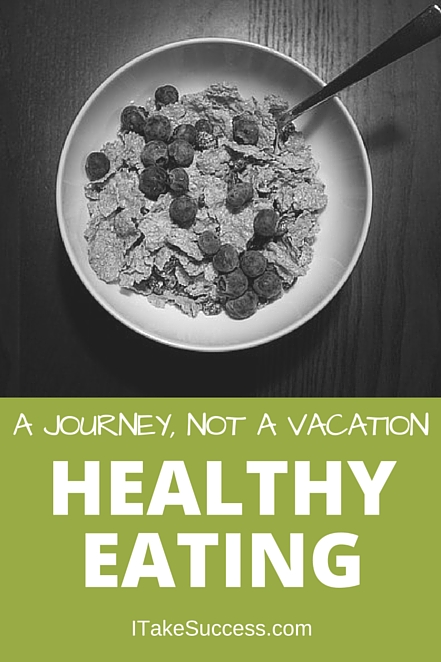
Healthy Eating is a Journey, Not a Vacation

Stop treating dieting like a vacation - try & then return "home;" start treating healthy eating as a final destination; the place you are going - for good!This time you are going to do it. You are going to eat healthier and loose weight. We have started on this road to healthy eating more than once, and somewhere along the way we turn around and head back to our processed food safety zone. It’s time to stop treating dieting like a vacation – where you go for a while and then come back “home,” and start treating healthy eating as a final destination; the place you are moving to – for good!

While I’m not personally trying to loose weight, I am actively trying to maintain a healthy weight; a task that is growing more difficult as I age. I am trying to instill healthy eating habits in my children. I am trying to help my husband to loose a few pounds. We are all wanting to feel more energetic and fit. This journey is not one that can be accomplished in a day, or a week, or even a month. It may take a year, or two. The good news is that each day you can move closer to your final destination one step at a time.

Step One: Choose water.

Humans are 75% water and therefore when we don't drink water we dehydrate (picture a prune, shriveled and dry). However when we do drink water there are many, many health benefits! Knowing when to drink water increases those benefits.Choose water over soda. Choose water over any sweetened beverage. If you don’t like the taste of water add a slice of lemon or lime -a particularly helpful trick to mask the taste of some tap water. While I could write an entire post on the difference between waters (tap vs. distilled vs. filtered vs. spring water – whew!), suffice it for now to say that you should just choose water.

If you currently don’t drink much or any water, drink a glass with your lunch or dinner. After several days of doing this, drink a glass with lunch AND dinner. Then start drinking water between meals. Work up to half your body weight in ounces. If you weight 150 pounds, drink 75 ounces of water a day. Yes, you will pee a lot. And many, many toxins will leave your body. So just do it!

Step Two: Smaller Portions

This was one of my husband’s biggest complaints: the smaller portions were not as satisfying and didn’t fill him up. I sometimes felt the same. Thankfully, we hung in there and after a couple of weeks we were feeling more satisfied with our meals. This came from several factors:

  1. I dished the meal out onto smaller plates or bowl. Silly as that may sound, if the small plate was heaped with food our psyche’s tricked us into thinking we were getting a full meal. Same amount of food on a large plate looked like we were getting a skimpy serving.
  2. Waiting 15 minutes after finishing a serving to see if we were still hungry. Sometimes it really wasn’t enough food (more on that below), but usually it was and it just took a few minutes for our stomach to get the message to our brains. Instead of having seconds and then feeling stuffed, we stopped at one serving and felt fulfilled – it just took a few minutes to make that realization.
  3. Healthy snack instead of seconds. If we were still hungry after waiting 15 minutes, then instead of seconds we ate some raw veggies and hummus, or peanut (or almond) butter and an apple. Sometimes we had a small handful of almonds or walnuts. If part of the meal involved a salad, then we’d have seconds on the salad.
  4. We kept reminding ourselves what the goal was. In that moment when you’re still hungry it is easy to succumb to the desire to eat more. But we reminded ourselves (and each other) how great we were feeling – and in my husband’s case, how much weight he was loosing. The motivation to stay on track with our goals often kept us from having seconds.
  5. Indulged every once in a while. There were some meals though that were just so awesome that we couldn’t resist a second helping, but we kept it small (not a full second serving). Allowing ourselves a little more once in a while of a healthy meal felt like a reward that wouldn’t jeopardize our progress. We were careful to save indulgences like this for healthy meals – and not pizza night!

Step Three: Start Where You Are

We were starting from a 90% prepackaged or processed meal point. Breakfast was frozen waffles or sugary cereal. Lunch was a heat and serve package or maybe a sandwich (white bread!), and dinner was an entree from the freezer or maybe pizza or other carryout. I don’t like to cook, but I really wanted my family to eat better. So we started with breakfast.

No more frozen waffles. We started drinking protein shakes made from vegan chocolate protein powder, frozen strawberries, spinach or kale, a banana, and almond milk. Whirl all that in a blender (I use a VitaMix), and yummy! Six mornings a week we have that. I tried a few different recipes in the beginning, but the family consensus was they liked this recipe the best. Makes my morning super easy and my shopping list is consistent (at least that part of it) as well. From there we switched out white bread for whole wheat at lunch for sandwiches and added salads to the mix. Our goal was to have most of our lunches be healthier than they had been.

Lastly, we tackled dinner. At first I wanted to make all the meals healthy, but that was unrealistic coming from a once a month healthy dinner start point. So we aimed for once a week in the beginning. Once that was a system, I began adding another dinner each week. I’m still not up to seven awesome dinners a week, because I honestly find the whole meal planning and prepping and making thing exhausting. (Did I mention that I don’t like to cook?).

You Got This!

The point is not to go from zero to sixty in a week. Remember that in order to make healthy eating be a lifestyle, you have to make it a journey. Your tastes will change over time. Your skills will improve. Your willingness to try new things will also be tested.

Don’t get caught in the “it’s not enough” cycle. I started making healthier meals, then I’d get wrapped up in “should I buy organic?” or “fresh versus frozen” for veggies or some other argument (with myself) that sometimes stopped me from making anything and resorting to old processed meal habits. Broccoli (fresh, frozen, organic or not) and chicken (fresh, frozen, organic or not) is better than a processed chicken and broccoli meal from the freezer section of the grocery store. Steam the broccoli, saute the chicken, and call it a meal. You can always make improvements over time. Remind yourself that making it yourself is better than relying on processed, so you’re already heading in the right direction even if you’re not using all organic, non-GMO, whatever-the-current-hype-about-food-is ingredients. You got this!

[Some links are affiliate links. While you will pay no more for the product or service, I may receive a small commission if you choose to purchase which will go towards supporting my blog and business. Thank you!]
Affirm the Positive

You know how you get all warm and fuzzy inside when someone compliments you? A nice feeling. Have you ever stopped to consider that you can tell yourself complimentary things about yourself as well? It’s okay. As a matter of fact – it is necessary for success.

Those statements of self-compliment are positive affirmations, and thousands of successful people use them to shape their minds into accepting the affirmed truth and then acting upon it.

I started using positive affirmations about two months ago. I began simply: three short statements that I recited out loud each morning. I also recited them before bed. I’d sometimes reciting them while driving to and from appointments. They were:

  • I have many financial opportunities.
  • My home is clean and tidy everyday.
  • I am grateful for the many blessings in my life.

Four days later I rewrote them, tweaking the existing affirmations and adding a few more:

  • I take full advantage of the many and profitable financial opportunities that come my way.
  • My home is always clean and tidy and my family helps keep it that way.
  • I am worth the time and effort it takes to make myself and my family healthy and delicious meals.
  • I focus on the tasks that propel me forward towards my goals.
  • I am grateful for the many blessing in my life.

Today I have 16 affirmations, including those above, that I recite every morning, some evenings, and whenever else I choose.

I began to see results immediately. Not all of these statements were “true” when I wrote them (and some still aren’t). But I want them all to be true and feel true. I am grateful for my many blessings, but I didn’t use to take the time to reflect on what those blessings are. Now I do – everyday. I’ve found myself become more gracious and forgiving.

The bane of my existence was the daily questions from my children of “what’s for dinner?” I don’t particularly like to cook (so much time to make – so little appreciation). At the same time I wanted my family to eat healthy meals, but I was often choosing quick, processed foods because it was an easier choice to make. My family deserved better – and so did I. Once I began reciting “I am worth the time and effort it takes to make myself and my family healthy and delicious meals” – I found myself in the kitchen contemplating and preparing something more complex that frozen pizza. Interestingly, my family has started verbally appreciating the new meals; I didn’t even prompt them, and they weren’t aware of my affirmation.

If you don’t already incorporate affirmations – positive affirmations – into your daily life, I encourage you to do so. Start small: three simple, short sentences with action verbs. If when you say it the words just don’t seem quite right – tweak it until it flows easily. Repeat each one three times every morning, out loud. You can also write each affirmation ten times daily if you prefer not to speak aloud.

Here’s a few to get you started:

  • I make healthy eating choices.
  • I have many financial opportunities.
  • I am in a loving and supportive relationship.
  • My home is clean and tidy everyday.
  • I let go of fear and pain. I live in love.
  • I am full of energy and vitality.
  • My mind is calm and peaceful.
  • I am beautiful/handsome.


Learn the Power of Breathing

100% of the top 100 successful people do it. 100% of Olympic gold medalists do it. 100% of the top 100 happiest people in the world do it. They breathe. Long, slow, focused breaths. Try it (because you know you already did, but do it again). Breathe in through your nose and out through your mouth. You don’t have to hold the breath in. Closing your eyes helps too (after you’ve finished reading this). I visualize the breath coming into my toes and filling my legs, body, arms, and the I exhale. That air leaves as quickly as it came in, taking with it my stress and worries. Sometimes I can feel chunks of stress fall off my shoulders.

In May I was in Indianapolis on business with some friends of mine. I spent much of the weekend being referee to some verbal arguments as well as just witnessing some downright ugly behavior. I didn’t realize how much stress I’d accumulated (indirect stress, as I wasn’t directly involved in the arguments), until I sat grabbing a bite to eat with another friend at the airport. As I sat, for the first time in four days, in a peaceful setting and took a few deep breaths, I could feel big, dry, caked-together chunks of stress fall off. My friend looked at me from across the table and remarked she could see the stress “falling away” as I took each deep breath.

Many of us don’t breathe properly. Our breaths are shallow and only use a portion of lung space. Deep breaths come from the diaphragm, the muscle below your lungs, and your stomach area should move in and out as you breath as opposed to your upper chest moving. Different breathing patterns can help you to relax, fall asleep, or even become more energized. So I put together a few videos on some breathing techniques that will find useful:

So today I charge you with the task of taking the time to breathe. It’s one of the first things I do in the morning – at least three slow, deep breaths. I repeat as needed throughout the day to combat stress, anxiety, or the daily craziness that comes from being the mother of two tweens.

Breathe.

I Like My Sleep

I really do. So it may surprise you to learn that I have given up sleeping in – completely.

It all stems from a podcast I started listening to a few months ago: Achieve Your Goals with Hal Elrod. I had chosen to listen to a few older episodes to get a feel for whether or not I wanted to subscribe to the podcast. In almost every episode Hal mentions his Facebook group, The Miracle Morning Community. So I decided to go check it out. 

It’s a closed group, but your request to join will be accepted. Full of positive people who start their day, not only early, but with a routine that involves self-reflection, exercise, reading, and journaling. I noticed that one of my FB friends was already a member, and I then remembered that she has mentioned her new routine a few times over the last few months – and how it has changed her life.

So I hopped over to Amazon and ordered Hal’s book, The Miracle Morning: The Not-So-Obvious Secret Guaranteed to Transform Your Life (Before 8AM)  [affiliate link] It arrived on a Friday – just in time to trade in my sleep-in even later weekend mornings for a 5:30 a.m. alarm. 

I’m never up at 5:30 a.m. unless I’m traveling and have to be on the road early. What the heck was I thinking?

I spent most of Friday evening devouring the words, especially the chapter on snooze-proofing your morning. I was going to do this, because it would be worth it, in time.

I’ve continued to work on perfecting my daily routine since creating my weekly tracking sheet, but life was often getting in the way. I could barely find time to get the “real work” done let alone find time to read for personal growth, to exercise, or to even breathe slowly. 

While getting up earlier was always a solution, it wasn’t the solution that I was looking for – until I was motivated by Hal and the others from the MM community. It was certainly worth a try.

So that Saturday morning I set my alarm for 5:30 a.m. I don’t think I slept all that well that night, probably wary of how quickly the morning was going to arrive. But one of the keys to getting up early is to affirm before going to bed “I like getting up early.” Upon waking your first thought should be along the lines of “I am rested and ready to start my day.”

I can’t say I jumped out of bed gleefully that morning, but I didn’t hit the snooze button either. I completed the six practices that   lead to achieving your potential. I felt good. Proud of myself for taking the initiative to make a change. I quickly realized that this was how I was going to get in my personal growth reading as well as strengthen my spiritual needs (an area that has been lacking greatly for the last few months). For the first time since I made it, I was able to take time to study my vision board; a practice that should be done daily, but that I never took the time to do. 

I’m happy to report that today was day 26! The first ten days, as Hal described in his book, are “unbearable.” It took a lot of will power to get out of bed – especially since I was traveling and staying up later than usual. The next ten days were indeed “uncomfortable.” More travel yielded later nights (3 hour earlier time difference didn’t help) – but I kept at it. These last few days have been wonderful. 

Daily Routine: Finding Your Rhythm

Figuring out your daily rhythm is important to setting your daily routine. If I had my druthers I would sleep until 10 am and be up until 1 or 2 in the morning. I can be very productive in the evening and tend not to get interrupted. However, I’m a wife and mother and my schedule has to mesh with the rest of the family.

Kids have to get to school in the morning with completed homework and packed lunches. Husband works outside the home and believes everyone should be up by 7 am since he has to be. So I’ve had to adjust my natural rhythm and it doesn’t always work out so well for me.

Currently I’m up between 7 and 7:30 a.m. By 8:30 the day is usually mine. At 3:00 p.m. school is out and kids return home. From then until about 8 p.m. I’m in mom mode – snacks, homework, dinner. Then there is some time available between 8 – 11 p.m. Depending on what has occurred during the daylight hours, my brain may be dead by 8 p.m. or I could be raring to go.

Unfortunately, I tend to enter a high productivity mode around 2 p.m. which then gets interrupted by the kids coming from school. I used to hit a high productivity mode in the evening, around 7 p.m., but that mode eroded away when my children were small. I have noticed that it’s showing signs of returning. The morning is peppered with interruptions from phone calls, emails, and the occasional visitor. What can I do make my available time more productive and weed out some of the distractions?

Firstly, I need to have a firm grasp on what must be accomplished that day, that week, and that month. This is being addressed by the task list worksheet I created at the beginning of this series. There are certain things that need to be done everyday, and some tasks that need to be dealt with less frequently. Unexpected things come up all the time and need to be added.

Secondly, I need to block out some distraction-free time. Do not answer the phone, the door, or emails. Do not check Facebook or Twitter. Potentially go media free for a bit. It is likely that this block of time will vary both in duration and in start time each day to fit in with my scheduled appointments and other obligations. But that’s okay. I’m coming from a very flexible and organic schedule. This flexibility suits my personality, but it would not necessarily be beneficial to everyone. Ideally, I will block out a part of the day that includes my high productivity mode.

Thirdly, I need to start taking a look at which tasks can be delegated to someone else – either a family member (in the case of planning meals), or a virtual assistant (for some of the business oriented tasks).

My work for the next few days is cut out for me: creating a system for this week that focuses on a schedule that best uses me highly productive modes and fits into my family’s schedule.

Have you determined your natural rhythm? What time of the day is your most productive time and does that fit in well with the rest of your schedule?

This post is Part 4 of a series on Daily Routines. Read more of the series:

Daily Routine: Anatomy of My Worksheet

Progress! At least there is something tangible to work with in my strive to create a daily routine and keep things from slipping through the cracks. It certainly isn’t perfect yet, and will undoubtedly transform as it gets used.

I went with a single sheet that will represent the entire week. There are several things that should be done EVERY day, but there are other tasks that just have to be completed within that week. One piece of paper keeps it simple, shows what has been accomplished so far – and what hasn’t.

Let’s take a look:

Weekly Checklist and Schedule
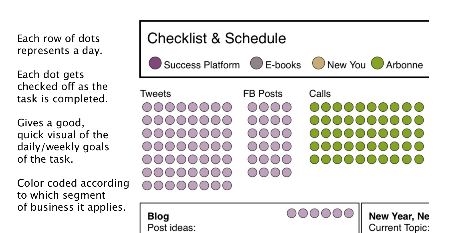
Thumbnail of my Task Checklist and Schedule sheet

Bare in mind that this is designed by me for me. So this particular sheet will not work for anyone else – BUT you will be able to get some ideas for formulating your own sheet.

At the top are a series of small circles – let’s call them dots – that each represent a task that should be completed X number of times a day. The first is “Tweets” with purple dots. I would like to tweet 8 times a day, everyday. Each time I tweet I check off a dot. The next set of dots is for “FB Posts” and are also purple. I would like to post on my “I’ll Take Success” Facebook page 4 times a day, six days a week. The next set of dots is in green and is for “Calls.” These are my ten daily calls (five days a week) for my Arbonne business. My goal is 50 calls a week, so if I don’t get all ten done in a day – or some days do more – I can just keep checking off those dots.

Closeup of dots for checking off daily tasks

So the dots work great for checking off any task that requires a quota per day or week, but doesn’t need any specifics recorded. That is, I don’t need to record what I tweeted, just that it got done.

The next part of the sheet is broken into sections. Each section is for a particular segment. Some sections have more dots – for those tasks that are not necessarily daily, but have more of a weekly quota and are pertinent to segment. For instance, the first section pertains to “I’ll Take Success” and concerns this blog. There are six dots, because I’d like to post six times a week. There is space for me to make notes about ideas for posts and also for my weekly newsletter.

I’m still playing around with the sections. It did occur to me that this layout would be ideal on a large bulletin board or white board. I could easily make notes throughout the week as things came up and needed to be added. But for now I’m sticking with the single sheet of paper as I work out the kinks.

And kinks there are. My sheet doesn’t give me a clear indication of what is most important to get done each day, so I’m going to need a way to prioritize my tasks. I do know that I don’t want to just have a long list of things that need to be done. That’s overwhelming, at least to me.

Next, I will take a look at how I can prioritize my tasks.

This post is Part 3 of a series on Daily Routines. Read more of the series:

Daily Routine: Goals and Tasks

Plan your work for today and every day, then work your plan. – Margaret Thatcher
Yesterday I wrote about wanting to nail down a workable daily routine and my homework was to create a list of the goals and tasks that would be part of this routine. Because I work from home, I have integrated some home tasks with work tasks.Here is what I have so far, broken down by goal and supporting tasks:Increase the visibility of my blog

  • Tweet 5-8 times a day
  • Post new content 4-6 times a week
  • Interact on Facebook
  • Read/write email
  • Weekly email newsletter

Further self-growth

  • Read book(s) 15-20 minutes
  • Read blogs 15-20 minutes
  • Listen to podcasts (when traveling in car)
  • Social interaction in person and social media

Write e-books

  • Research
  • Write
  • Prep and Publish

New Year, New You Series

  • Develop content
  • Research
  • Write
  • Schedule venues
  • Promote

Arbonne (MLM company)

  • 10 calls/interactions
  • Check stats and website for updates
  • Place orders
  • Interact with team
  • Coaching

Fine Needle (online yarn shop)

  • Read emails
  • Ship packages
  • Update web store
  • Knit on sample(s)

Domestic

  • 1-2 loads of laundry
  • Sort mail
  • Pay bills
  • 15-20 minutes organizing
  • Plan meals

Wow! Will there be enough hours in the day?! Seems a bit daunting, but some of the items don’t necessarily have to be done every day. And some of the items may be outsourced, although most of the tasks listed will be handled by me at this point.

The next step, other than continuing to refine my list, is to determine how much and how many. How much time should be devoted to task and/or how many tweets/posts/calls in daily quota. Some of those numbers I already listed, but now I want to see what things I can group together, even if they are tasks from different goals.

How do you combine or group your daily tasks?
This post is Part 2 of a series on Daily Routines:

Daily Routine: Getting One

Having been self employed for close to 20 years, I’ve had a very flexible schedule. I’ve generally lived each day as “what do I need to accomplish today or this week?” With launching this new business, I’m finding that my usual lackadaisical attitude just isn’t going to cut it. I need a real daily routine.

Between making connections on social media, writing blog posts, and working on my Network Marketing business, there are a lot of little things that fall through the cracks if I’m not careful to keep a checklist of tasks and goals.

Notice I mentioned goals. Because every task, no matter how mundane, should be contributing to a goal. Otherwise, why would you do it? Equally important is to make sure that time is wisely spent. No sense in spending 3 hours on something that ultimately won’t make a significant impact on the goal.

Now this new daily routine isn’t going to magically come together in one day – or probably even one week. Most likely it will require constant tweaking as my goals are met and change. But I’d like to get a basic foundation in place within the next couple of weeks.

So today I am going to list my goals and the daily and weekly tasks associated with those goals. If you are interested in developing or revamping your daily routine, then join me on my journey. Make your list of goals and tasks. If it seems daunting, then focus on one goal and the tasks required to make it happen. Check back tomorrow to see my preliminary list!

What tasks are part of your daily routine?

This post is Part 1 of a series on Daily Routines. Read more of the series: