Are you being kind to yourself?

Not with Rewards

Are you kind to yourself? Stop saying negative things to yourself and start affirming the positive. You ARE awesome. Start saying it!Oh sure, you reward yourself with a piece of cake or a new piece of jewelry once in a while. But those are rewards, and while it is nice and kind to do something “extra” for yourself, the real question is: are you kind to yourself every day?

Kind Self-Talk

“I’m so stupid.” Do you say that to yourself? Know this: it’s not true. Perhaps you poured OJ into your coffee instead of milk. That doesn’t make you stupid, it just means you weren’t paying attention at the moment. In most cases, when you tell yourself you’re stupid, you are reacting to a situation in which you’re not performing at your best. You may have done something stupid (and I’d prefer to say you did something not so smart), but that doesn’t make you stupid. So stop saying it. I hear people, particularly women, say this aloud about themselves all the time. Take notice if you’re doing it, and stop.

There are other phrases of unkind words we say to ourselves: I’m fat, I’m not good enough, I’m ugly, I’m a bad mother/wife/partner/sister/friend. Stop it. You have the power to change your reaction to whatever situation is causing you to say those things. And you can start making that change by changing how you talk to yourself.

Instead of saying “I’m fat” try:
– I am in control of my health.
– I am choosing to be healthy.
– I am awesome.

Instead of saying “I’m not good enough” try:
– I am a winner.
– I am successful.
– I love myself for who I am.

Instead of saying “I’m ugly” try:
– I am my own unique self.
– I am comfortable with who I am.
– I am special.
– I am beautiful.

Instead of “I’m a bad (insert relationship here)” try:
– I am patient and kind.
– I am a source of love and inspiration.
– I am loving and passionate.
– I am love, loved, and loving.

These alternatives are all positive affirmations, short positive statements that are true (or you want to be true). Repeating them aloud or writing them down every day instills the affirmation into your subconscious and it will change the way you think about yourself. For those who doubt this and think it’s some New Age hype, let me just remind you that all those negative things you’ve been saying have gotten you where? This is basic human psychology. So make a concentrated effort to write down three positive affirmations and say them aloud every morning for a week. See if you feel a difference. I know you will.

If you’d like more information on positive affirmations, including over 300 more affirmations covering everything from finance to creativity, then check out my book, Positive Affirmations.

Kindness Matters

I think that people are inherently kind. I also think that even though people are essentially kind they find it easy to squelch that impulse. And so sometimes we have to make ourselves be kind. Not that we want to be mean or hurtful, but we have to make an effort to be kind, or perhaps I should say, kinder.

Kindness matters. Even the smallest act of kindness has the potential to make a big impact on a person. So make an effort this week (and always) to incorporate one or more of these five small acts of kindness into your daily routine:

  1. Smile. Smile when you’re talking on the phone. Smile at strangers. Smile at your family and co-workers. Smiling releases endorphins (natural painkiller) and serotonin (natural antidepressant) in your brain. When someone sees you smile, their brain releases serotonin too. If they smile back at you – double whammy for you, because you get yet more serotonin! That feels really good.
  2. Tell those you love that you love them. Every day. Has it been a while? Feeling a bit awkward about it? Start small. “I love the way you are always looking out for your brother” or “I love that you take the time to ___.” If saying the word love is hard, use appreciate: “I appreciate you.” Work up to saying “I love you.” Once you get there, say it every day.
  3. Pay compliments. Make them sincere. If you don’t have something nice to say, try harder to think of something. Still stuck? Try completing this sentence: “I really appreciate the effort you are making to ___.”
  4. Stop complaining. Stop complaining about others; stop complaining to others. If you find yourself caught up in a hate-fest, then take the initiative to say, “Stop. I’m trying to be more kind. Can we change the subject or find something that we are grateful for about this person/situation?”
  5. Say “please” and “thank you.” You know you were taught this as a child, but are you still doing it? Get back in the habit if that’s a habit that you’ve let slip.

These simple things can make you and those around you happier. Start today. Start right now, actively practicing kindness.


6 Ways to Relieve Stress

Stressed to the Point of Implosion

Does hair-pulling, shoulder-tensing stress have you wadded into a ticking time bomb? Diffuse that stress with these 6 easy tactics to relieve stress.Does hair-pulling, shoulder-tensing stress have you wadded into a ticking time bomb? Diffuse that stress with these 6 easy tactics to relieve stress.

I’m sure I’m not alone when I say that money issues often stress me out. Two-thousand-fourteen had a whopper of those. I closed a retail business at the end of 2013 to start my coaching practice. I had enough in savings to get me through the year while the new business got started. Unfortunately two roofing issues and some major house construction (a result of the roofing issues), ate into that savings quite a bit. To further add to the mix, my husband’s job was no longer as secure as it was six months ago.

6 Techniques to Relieve Stress

Without the techniques that I’m going to share with you, I would be a nervous, tense, sleep-deprived wreck at this point. Such a state would certainly hinder any momentum to move forward, both personally and with the coaching practice. Thankfully I began implementing several of these techniques even before the stress factors kicked in full force.

  1. Breathe. Slow, deep breaths. If you are a regular reader, you know that I preach breathing. I am aware of when a situation is causing my blood pressure to rise or my muscles to tense, and before I react in any way, I breathe. Three slow, deep breaths. Try it right now. It’s very calming.
  2. Drink water. If you’re dehydrated your level of the stress hormone cortisol increases. Aim to keep your base stress level as low as possible, and water will aid you doing that.
  3. Meditate. If you don’t have a regular meditation practice, start out easy: five minutes of quiet deep breathing. Alternatively you can listen to soothing music, practice yoga, or participate in a relaxing aspect of a hobby or sport (gardening, knitting, singing, cooking, drawing, dancing, running, kayaking, swimming, etc.).
  4. Be aware of what you can control and what you can’t. Staying up all night worrying about things I can’t control isn’t going to solve any problems. Believing that I will find a solution to any problems that arise, and getting a good night’s sleep so that I can be clear-headed in the morning is much more beneficial. Not always easy, but certainly a  calm and rested mind can make better decisions than one that is fraught with worry.
  5. Say positive affirmations every day.  This has helped me so much that I wrote a book on the power of positive affirmations and how to use them. Here are a few to help you if you are feeling stressed:
      • I am responsible for the success I achieve.
      • I am confident, competent, and calm.
      • I am capable of any task given to me.
      • I deal with problems immediately.
      • I live in an abundant universe.
      • I invite and allow money in my life.
      • My days are rich with opportunities.
  6. Express gratitude. I wake up and think about three people for whom I am grateful. Before bed I think about three things for which I am grateful. The day before Thanksgiving 2013, I stood in my basement surrounded by 12 large plastic tubs that were gathering the gallons of water pouring in from our roof issue. I stood and cried, not because of the water coming into my house, but because I was still going to be able to spend Thanksgiving with my husband and children. A pastor’s family in our community was not. That same day a man set himself on fire and ran into a local church, setting the church offices on fire. The pastor didn’t make it out of the building in time. So be thankful for what you do have, and make a conscious effort to think about people you are grateful for every day. Go beyond just thinking about the people, actually express the gratitude: write a letter or a short note, give the person a call, or if they’re no longer living, write about them in your journal.

Practicing these techniques has given me a safe and calm anchor point. I can find that anchor at any given moment which helps me keep things in perspective. I’m less likely to overreact and more likely to make rational decisions based on fact and not emotion.

Try to implement one of these techniques today (I’d start with the breathing). Continue practicing that technique daily while adding in a new technique every couple of days. Do you have any techniques you already use to help you cope with stress? Please share in the comments or on our Facebook page.

Awareness of Influence

Who Are You Spending Your Time With?

“You are the average of the five people you spend most of your time with” says Jim Rohn, renowned businessman and motivational speaker. Are you aware of who you are spending most of your time with?

Take a moment to write down the five people with whom you spend the most time interacting on a regular basis. Perhaps it’s co-workers, your spouse/partner, or friends. Now rate how much of a positive influence that person is on your life. Do they help and support the goals you are trying to achieve? Or are they usually sabotaging (even if innocently) your efforts for self-improvement? You can assign each person a numerical rating on a scale of 1 to 10 (with 10 being most positive influence or makes you feel most uplifted), and take the average.* Are you happy with the result?

Who’s Opinion Influences You?

I would go so far as to say it’s not just the amount of time, but even more so the person’s influence on you. How much do you rely on this person’s opinion and character in making your decisions? You may only spend 20-30 minutes a week conversing with your mother (and in contrast spend much more time each week with co-workers). If your mother is always putting you down or being unsupportive of your goals or questioning your relationships, you may place more value on her opinion than you do a co-worker with whom you share a cubical, and spend 40 hours with every week. Your mother is, after all, your mother. So now go back to your list and revise to include those with whom you may not spend an exorbitant amount of time with, but whom have a strong impact on your decision making process – positive or negative. Add no more than two or three, and it’s possible you aren’t adding any as they may have already been included in your original list. Rate the new people added, but don’t average them in.

Now compare their rating to your average; is the rating higher or lower than your average? If lower, than you will want to lessen the amount of time (further) or lessen the amount of influence that person holds over you. If it is higher, than you will definitely want to spend more time with this person.

You Influence Others As Well

It is important to be aware of what influence your interactions have on others as well. Are you supportive and inspiring with others? Are you contributing to the negativity? Strive to be helpful and positive. Your gestures don’t have to be grand, as many small actions can add up. Improving and growing yourself will in turn help others to improve and grow.

Take time this week to really think about who you spend most of your time with. Are these the people that are going to push you UP or drag you DOWN?

* add the five ratings and divide by 5 to get the average.

Awareness of Food and Eating

Your relationship with food matters

You are what you eat – or so the saying goes. So how aware are you of what you are consuming on a daily basis? How aware are you of your relationship with food? That’s right, relationship. A lot of people do not have a good relationship with food, and I don’t mean that sometimes eating onions gives you indigestion. While being aware of what foods cause you gastronomic distress is a good thing, it is critical to your health and well-being to have a good relationship with food.

Think about how you feel in regards to the following statements:

  • Food’s purpose is a source of nutrients that fuel my body
  • I forget to eat if I’m busy doing something else
  • I find myself snacking all day, especially on things that are sweet or salty (or both!)
  • I’ve been known to polish off a bag of chips or pretzels while watching television
  • I can’t get my day started without coffee. Lots of coffee.
  • I love food, but food doesn’t love me
  • I listen to my body for clues as to what I should eat

Food as the necessary evil

This was my relationship with food for a long time. I had better things to do than spend an hour in the kitchen whipping together a meal that would take ten minutes to consume. That just didn’t seem like a good return on my time investment. As a result, I either skipped a meal, or chose something quick and usually processed to consume.

In the past year, I’ve begun to change my mindset about food. Instead of looking at food preparation as a chore, I’ve come to view it as an opportunity to take a break and meditate. I’ve chosen to make my health a priority, and in doing so I’m more concerned about what foods I’m putting into my body. This shift has allowed me to look at food in a different way: more as a life sustaining force and less as a means to stop my stomach from growling. Food preparation has become a sort of meditation practice: the chopping of the vegetables, stirring the soup or sauces, smelling the herbs and spices, spreading the nut butters on toast – whatever action of preparation I do, I do it fully aware of how it is transforming the food which will in turn nourish and transform me.

How you eat is as important as what you eat

I am also mindful as I eat. I chew each bite as much as a can, savoring the flavors and texture that bite of food has to offer. This also allows the enzymes in my mouth to begin breaking down the food, which means a bit less stress on my stomach enzymes and easier digestion. All that chewing takes time and slow eating makes you feel full with less food consumed.

Although I’ve been undergoing this mind shift about food for almost a year, it is still a process that I have to think about; it doesn’t come naturally to me to think of food as a friend. For a while that bothered me. Surely if I “practiced” my good eating habits I should start prepping and eating healthy meals without giving it much thought. But I realized it is the giving it thought that is the healthy part. The awareness of the preparation and eating is the very thing that is nourishing my soul while the food itself is nourishing my body.

Spend some time this week being aware of what you are eating and how you are eating. When you are aware, you are more likely to make healthier choices and to not overeat. Share your thoughts over on our Facebook page.

Becoming Aware of Who You Are

Your personal growth is greatly enhanced by becoming more aware of who you are as a personPersonal growth is the process of improving oneself through activities that develop talents and potential, which in turn make you more employable, enhance your quality of life, and lead you to realizing your dreams and aspirations. Your personal growth is greatly enhanced by becoming more aware of who you are as a person.
In order to develop your talents, you have to be aware of what they are. Your awareness cannot stop there, you must also realize the best way for YOU to develop that talent and potential. Your method of learning may not be suited to someone else.

There are a multitude of online “tests” that will give you insight into the type of person you are. It is best to use these results not as a definition of who you are, but rather as a way of understanding why you are the WAY you are. I always like to read over the results to see with what I agree and disagree. Lots of insight can be gained just from that! There are links at the end of this article to some of the personality tests you may find insightful. Remember, no one personality type is better than another.

Action is born out of awareness

Actions that you take, particularly positive and forward-moving actions, are a result of your being self-aware. If being around crowds of people makes you anxious, and you are aware of this, then you know what actions you can take to avoid or minimize your interaction with crowded situations. I don’t go shopping at the local mall between Thanksgiving and Christmas because I don’t like crowds or the noise or the rush. This means that in order to get my Christmas shopping done, I have to shop early and/or shop online. Do I miss out on some great deals? Maybe. But I keep my sanity, and for me, that is worth more.

As you start to think about your goals for the coming year (you are starting to think about them, right?!), you will better be able to set up actionable steps if you are aware of what works and doesn’t work for you. If you have consistently failed to reach goals in the past, it may not be the goals themselves that are the issue, but rather the actions you are taking to try to achieve them.

How self-aware are you?

The definition of awareness is “knowledge or perception of a situation or fact.” Self-awareness is not just about being aware of what you are doing; you need to be aware of what you are eating, who you are associating with, and how you react to stress and other emotional triggers. Being fully aware is minimizing the amount of time you spend functioning on autopilot.

I’ll be spending this week posting about awareness, particularly self-awareness in the aspects of eating, personal associations, and stress triggers. The discussion is ongoing over on our Facebook page and on Twitter. Please join us and share! Sign up for our mailing list to receive links to all the Awareness Posts.

Links to online personality type “tests”:

Myers-Briggs

Big Five (I found this one quite insightful, even though I didn’t agree 100% with my results)

Ayurveda (more about body type, but insightful to personality traits are well)

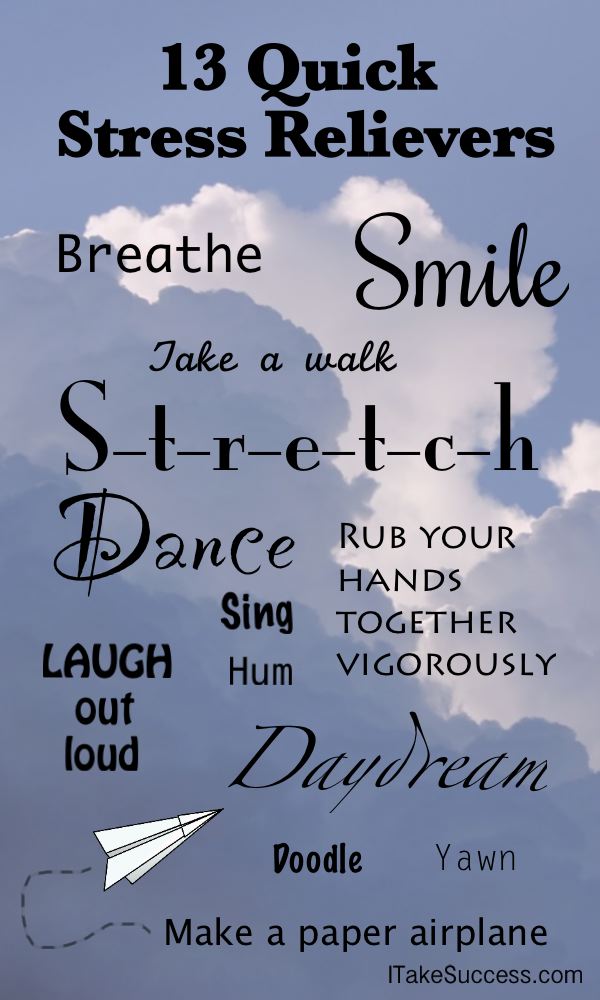
13 Quick Stress Relievers

Every day comes with at least some stress, but with the holidays approaching, even those who consider their lives low stress start feeling a bit more anxious. Those with high stress to start with often compound their stress just thinking about how much more stress there will be. Whew!

So here are 13 things you can do in less than five minutes (some in under a minute) that will help to take the edge off:

13 Quick Stress Relievers you can do in under 5 minutes

1. Breathe.

I sound like a broken record on this, but this one thing can make huge difference in your reaction to a situation. Take a moment and breathe deeply and slowly. Three times. Do it now. Then…

2. Smile.

If you have to fake it, that’s okay – just don’t turn it into a snarl. Repeat if necessary. Repeat even if not necessary. Smile at a stranger for an added boost of serotonin and endorphins (which make you feel good). When they smile back, you get a bonus boost!

3. Take a walk.

You’ll get more out of a 40-50 minute walk, but even five minutes, especially in fresh air, will do you and your body good.

4. Stretch.

Reach both arms above your head and stretch. Better if standing, but even just reaching above your head while sitting will have benefits. Pointing and flexing each foot (ideally with leg extended) can also be done while sitting.

5. Laugh out loud.

LOL for real. Think of time when you laughed really hard over something – you don’t even have to remember what you were laughing about, just remember the sensation and try to duplicate that. You may not get to that level of laughter, but you at the very least genuinely smile and probably even giggle a little.

6. Hum.

Hum a tune, say the word hum and hold the “mmm” sound, whatever.

7. Sing.

Sometimes this one is best done when you’re alone, and if you are then sing at the top of your lungs! Aim for an upbeat song.

8. Dance.

It’s okay if the music is only in your head. Just move, shake, and bop around for a few minutes. Take a bow.

9. Daydream.

Take one minute to imagine yourself doing your favorite activity, or relaxing, or winning the lottery. See it, hear it, smell it, taste it, feel it. (Set a timer if you’re afraid you’ll get sucked in too deep to your daydream to come back to reality).

10. Rub your hands together vigorously.

As if you are trying to warm your hands, rub your palms together for about 15 seconds. When you stop, feel not only the heat, but the energy force between your hands as you slowly separate them.

11. Doodle.

Scrap of paper and a pencil. Draw something: a line, circles, a picture, anything. There’s a lot to be said about the power of doodling.

12. Yawn.

Open your mouth really wide and it will come. It may even happen a few times, and that’s okay.

13. Make a paper airplane.

Flying it is optional. It’s the process of making that will help lower your stress level. I like to make tiny ones out of sticky notes.

Keep this list handy for anytime you need a quick dose of stress reduction. You can Pin the graphic from here, or visit our Pinterest site for this and more great stuff: http://www.pinterest.com/ITakeSuccess/quotes/

What do you do to relieve or reduce stress?

Dusting Off the Ivories


In a short amount of time – just over a week – I’ve gone from stumbling through this piece of music to being able to confidently (but not perfectly) play the first page.


I learned to play the piano as a child. My mother is a classically trained musician and music teacher, and I took lessons from her advanced students (you can’t teach your own child was her philosophy). I practiced, sometimes for hours at a time (in my mind), but usually not my lesson songs. I was drawn to show tunes and some popular music (most notably “Nadia’s Theme” also known as the theme from “Young and the Restless.” [listen here]). Sitting at the piano was a form of meditation for me; I could get lost in singing and playing and not worrying about homework or grades or what I was going to do when I grew up.

Despite all that “practicing,” I wasn’t a great pianist. Good enough to make it through a few hymns on Sunday if my mother (the church organist/pianist) was unavailable (and the substitute pianist was also unavailable). Good enough to entertain myself once in a while with a song or two. Good enough to help my children with their lessons.

Recently I started listening to Pandora Radio before bed, and I chose a channel I called “Lullabye Radio.” It has turned out to be a nice variety of contemporary lite music and classical. Often there are beautiful piano concertos, again contemporary and classical. And I started yearning to spend some time at the piano again.

So everyday, I take no more than 10 minutes to sit down and play. I started with Tchaikovsky’s Opening Theme from Piano Concerto No. 1, [YouTube video, but not of me!)] which I randomly selected from my mother’s music cabinet. After a week, I’ve gotten fairly confident about page one. Page two is decidedly harder, but I’m going to start tackling that soon. (My version is shorter than the YouTube video to which I link above).

The point of this rather long winded story is that in a short amount of time – just over a week – I’ve gone from stumbling through this piece of music to being able to confidently (but not perfectly) play the first page.  I’ve spent 5-10 minutes a day going over the same piece of music. I don’t sit down with the intention of perfection, but rather the intention of improvement. And each time I get a little better. Better than if I were to have sat for 2 hours straight and repeated the selection over and over. Each day I’m focusing on one thing for that brief amount of time – a form of meditation for me. My spirit is uplifted, I’m refocused and better able to attend to my other tasks of the day.

Do you have a meditative habit that you use to refocus? I’d love to hear about it in the comments below or on my Facebook page.

Meditation: When Your Mind Races Faster

When talking to people about meditation, I often hear this: "I try to meditate - clear me mind - but my mind starts racing! Meditation doesn't work for me."When talking to people about meditation, I often hear this: “I try to meditate – clear me mind – but my mind starts racing! Meditation doesn’t work for me.”

The racing mind is a common problem with those new (and maybe not so new) to meditation. Except that maybe it’s not really a problem but exactly what you’re aiming for. You just cocked your head and thought, “isn’t meditation clearing your head of thoughts?” didn’t you?! But I ask you – WHY no thoughts?

Reasons for Meditating

Go back to your original reasons for undertaking the practice of meditation. Relaxation? Because you were feeling creatively blocked? Because you couldn’t focus and weren’t finding solutions easily? Because too much “life” stuff keeps getting thrown your way and you can’t “hear yourself think”? Ultimately, aren’t you trying to relax and seek a few moments of peace and quiet to that you can then think more clearly?

Real Ideas

The next question is whether or not these racing thoughts are water cooler caliber gossip or are real ideas. And sometimes what starts out as drivel (It annoys me when Joe taps his pencil on the desk when he’s working) can lead to (and often quickly) a series of thoughts that can be quite valuable. (Maybe there should be pencils shaped like drumsticks). You just so happen to work for a pencil company. You present your idea and whammo, big bonus and a promotion. [There are pencils shaped like drumsticks on the market, check them out on Amazon.com]

The point is that the very end goal of meditation for you may not be an empty head. And while that’s not to say you shouldn’t try to clear your mind when you sit down to meditate, you shouldn’t necessarily become frustrated if thoughts start pouring into your mind. Now the focus will be on one thought at a time.

Case in Point

There was a morning when I first started meditation in which the ideas started flowing so rapidly that I had to write them down. I quickly opened my journal and took some notes. At that time I was too new to know how to wrangle the thoughts so I could further develop each one. But at least by jotting them down I had something. Later that morning I fleshed out my notes on at least a few of those ideas.  I glanced back through my journal while writing this post to find that list. I had scribbled down seven ideas. Two of those I later wrote some details about. Looking at the list now, I have no idea what three of them are about, but those remaining two ideas have sparked some new ideas. Now that I’m “better” (perhaps the term is “more focused”) when I meditate, I will be able to bring each of those ideas to mind and follow it where it goes. As it blooms in my mind I’ll grab my journal and start writing.

That’s how this blog post came to be. I began my morning meditation thinking of people I’m grateful for and my friend Susie came to mind. The string of thoughts that followed were diverse, but each thought led to another – and I followed each one until it led me to the theme of this post. Then I knew it was time to break open the journal.

As a side note, the first half of this post “wrote itself” – I just let the words form on the page as they tumbled from my head. As I came out of my relaxed meditative state, as my conscious mind started paying more attention to what was going on, I had to “think” more about what I wanted to write. Any time that became more taxing than I would have liked, I took a deep breathe or two or three and focused. The words flowed again.